
Yazy the yatzy dice game
FIOGONIA LIMITEDBoard
4.715.21K Reviews
- Version
- 1.6.1
- Installs
- 1.00M
- Age Rating
- Everyone
Screenshots
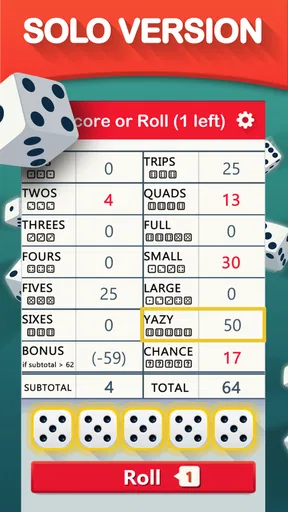
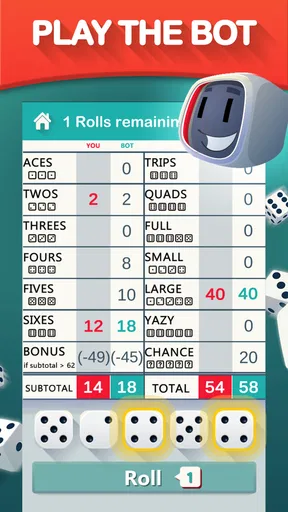
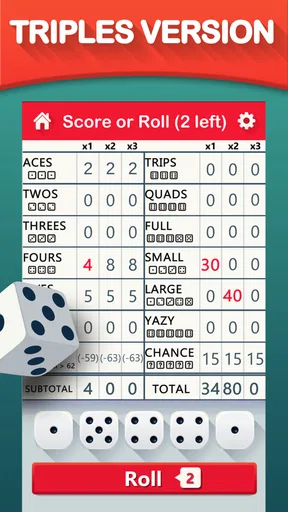
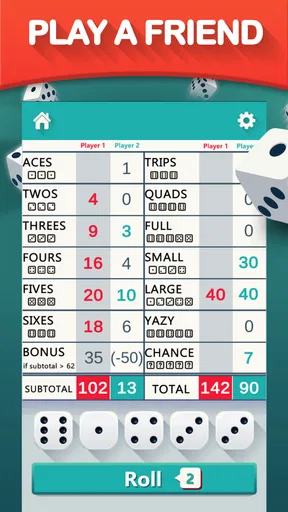

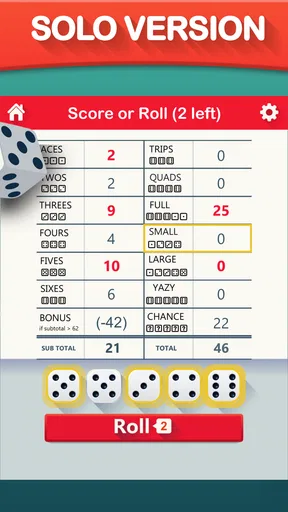
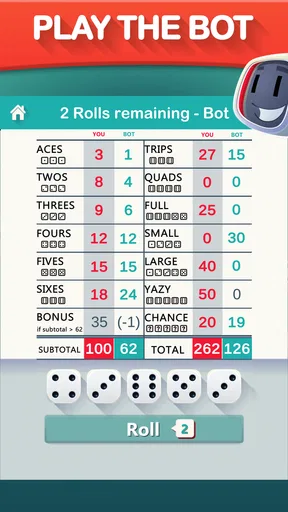
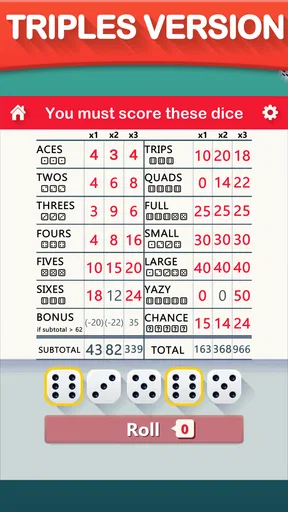
Our Review of Yazy the yatzy dice game
 Analysis by Appyee
I approached Yazy as the kind of board game I could open for a short break without studying a rulebook first. That first impression still feels accurate: it is a dice-based game built around quick decisions, familiar scoring ideas, and the small tension of deciding whether to keep a useful roll or chase something better. It is free to download, rated for Everyone, and developed by FIOGONIA LIMITED, so it is easy to consider for casual play at home or on the go.
What makes it worth a closer look is not a complicated collection of modes or a large learning curve. The appeal is more focused. You roll, assess the result, choose what seems most valuable, and try to turn a limited number of opportunities into a strong score. I like that structure because it gives even a short session a clear purpose. You are not simply tapping through turns; you are making small probability-based choices that become surprisingly engaging once the score starts to matter.
Getting comfortable with Yazy from the first roll
The game has been available since May 18, 2017, and its current version is 1.5.2. It runs on Android 7.0 or later, which makes it accessible on many older devices as well as newer phones. Its store presence is substantial, with more than a million installs, a 4.7 average from around forty-one thousand ratings, and about fifteen thousand written reviews. Those figures do not replace personal experience, but they do suggest that the simple dice format has found a durable audience.
When I first open a game like this, I want to understand three things quickly: what I am trying to achieve, what each roll allows me to do, and how the game tells me that a decision has been accepted. Yazy is best approached with that mindset. Rather than trying to optimize every move immediately, I recommend treating the first round as a guided practice session. Pay attention to the available scoring choices, watch how a roll changes after you decide what to keep, and notice how the game presents the result of each selection.
That approach is especially useful for people who know the general idea of yatzy but have not played this particular version. Familiarity with dice games gives you a head start, yet the practical details still matter. The most important early habit is to pause briefly before committing a result. A roll that looks exciting may fit several possible scoring paths, while a less dramatic roll may already be the safest way to secure useful points.
The first meaningful success is not necessarily a spectacular score. For a new player, it is successfully completing a turn while understanding why the chosen category was sensible. Once that clicks, the game becomes much less about guessing and much more about managing risk.
What the opening session feels like
Yazy is a board game in the broad sense, but it does not feel like a long tabletop commitment. The dice create a compact loop: make a roll, inspect the possibilities, decide what to preserve, and use the remaining opportunity carefully. That makes it suitable for a coffee break, a few minutes before an appointment, or a relaxed evening when I want something interactive but not demanding.
The pace also makes it approachable for mixed-age play. Because the content rating is Everyone, families can consider it as a simple introduction to dice-based scoring. Younger players may enjoy the visible excitement of repeated rolls, while older players can focus on planning and probability. I would still explain the basic decision process rather than handing over the phone with no context, because the fun comes from understanding why one option is better than another.
For a first-time user, I would avoid chasing the most ambitious combination at every opportunity. A common beginner mistake is to treat every roll as a reason to gamble. In practice, a reliable score can be more valuable than a dramatic possibility that depends on several unlikely outcomes. I found the game more satisfying once I started separating “this could become excellent” from “this is already useful.” That distinction is the foundation of better play.
How to make the first successful choice
Imagine opening the game during a short lunch break. You have enough time for a focused session, but not enough patience for a complicated setup. Your first roll contains a couple of matching values and several unrelated dice. The tempting reaction is to hold the pair and hope the rest improves. That can be reasonable, but I would first look at the scoring options and ask whether the pair already supports a dependable category.
This is where Yazy rewards a small amount of discipline. Keep the dice that serve a clear purpose, not merely the dice that look interesting. If you are building toward a matching result, preserve the strongest foundation. If the roll is scattered, consider whether chasing a difficult pattern is worth giving up a more predictable score. The right choice changes with the situation, but the question stays useful: What result can I realistically improve from here?
Another helpful habit is to think about future turns rather than judging one roll in isolation. Spending a turn on a weak category may be sensible if it protects better opportunities later. Conversely, using a valuable category for a mediocre result can leave you with fewer ways to recover. New players often focus only on the number appearing immediately on screen; experienced play comes from considering what that decision removes from the rest of the game.
After a successful turn, take a moment to read the updated score rather than rushing into the next action. This helps connect the dice you selected with the points you received. It also reduces one of the most common sources of frustration: believing that the game ignored a good roll when the chosen category simply valued a different part of it.
Where beginners can become confused
The main challenge is not learning what dice are. It is understanding that a roll can be valuable in more than one way, while a single turn usually asks you to commit to one direction. A set of equal values, a sequence, and a collection of high numbers may all compete for your attention. The interface may show the immediate result clearly, but the strategic meaning still comes from the player.
I also recommend checking the wording of each scoring choice before making a fast tap. Familiar names can create false confidence. Two categories may appear similar at first glance, yet one may reward a specific pattern while another counts values more generally. If you are unsure, use an early turn to test your understanding rather than trying to protect a perfect score from the beginning.
Another point of confusion is the difference between a lucky roll and a good decision. You can make the right choice and still receive an ordinary result. You can also make a risky choice that pays off once. I judge my play by the quality of the reasoning, not only by the final number. That attitude keeps the game enjoyable and makes improvement easier, because every turn gives you something to review.
There is also a practical limitation to the format: dice games naturally include randomness. If you want a contest where careful planning almost completely determines the outcome, this will not satisfy you. Yazy gives you decisions inside a random structure, not total control. I see that as part of its charm, but players who dislike luck-based swings should choose a more deterministic board game instead.
Small strategies that make the game more rewarding
My first useful tip is to protect flexibility early. When several scoring paths remain available, do not automatically spend the most versatile option just because it is available. A flexible result can rescue a later turn, especially after an unlucky roll. This is not about hoarding everything; it is about recognizing that some outcomes are easier to use in multiple ways than others.
Second, avoid judging a category only by its maximum possible score. A high ceiling is attractive, but the chance of reaching it matters too. If a category requires a very specific arrangement and your current roll is far from that arrangement, repeated chasing may cost more than it gains. I prefer to ask whether the next roll meaningfully improves the position. If it does not, taking a modest result can be the more intelligent move.
Third, use the middle of a session to reassess rather than continuing with the same plan. Early decisions may leave you with a particular set of categories, and later rolls should be interpreted in that new context. A strategy that made sense at the start can become wasteful once the remaining options change. This simple reset is one of the easiest ways to move beyond beginner play.
A fourth insight is useful when playing with someone else: do not copy their choices automatically. Two players can receive similar rolls but have different scoring needs. Your opponent may be comfortable taking a small guaranteed result because of their earlier choices, while you may need to pursue a more ambitious outcome. Comparing decisions can teach you a lot, but copying them without considering your own position usually does not.
Finally, treat short sessions as practice rather than incomplete versions of a serious game. Because the core loop is compact, you can experiment with conservative and aggressive choices without investing a large block of time. I learned more by deliberately testing when to stop chasing a pattern than by trying to play perfectly from the first round.
Who will enjoy it, and who may prefer another option
Yazy is a strong fit for someone who wants a straightforward dice game with enough decision-making to stay interesting. It works well for players who enjoy probability, light strategy, and the satisfaction of improving a score through better choices. It is also a sensible pick for a first board-game download because the basic loop is easy to grasp and does not require a large collection of rules.
I can see it working particularly well for a family member who wants something less intense than a competitive strategy title. A parent and child can discuss whether to take a safe result or try for a better combination, turning each turn into a small lesson in risk and reward. It is equally suitable for solo downtime, provided you are comfortable playing against the structure of the game rather than needing a deep story or a large world to explore.
On the other hand, I would not choose it for someone looking for elaborate campaigns, character development, or rich cooperative systems. It also may not be the best alternative to a traditional physical set if your main goal is face-to-face conversation around a table. A mobile version is convenient, but it cannot fully reproduce the social atmosphere of passing real dice and keeping a paper score sheet.
Compared with a basic dice roller, Yazy offers a clearer purpose and more meaningful progression within a session. A generic roller can be useful when you already have a physical ruleset, but it leaves the scoring and structure to you. Here, the game gives the rolls a framework, which makes it easier to start playing immediately. Compared with heavier board-game apps, it is much quicker to learn, though it naturally provides less variety and less long-term complexity.
Free access and the practical trade-off
The game is free to download, which lowers the barrier for trying it casually. It includes in-app purchases ranging from $2.99 to $99.99 per item, so I would keep that in mind before handing the device to a child or allowing unrestricted purchasing. The presence of optional purchases does not change the basic appeal of the dice gameplay, but it is still worth checking your device’s purchase controls if the phone is shared.
For me, the important question is whether the free starting point gives enough room to decide if the format suits me. A player who enjoys short, repeatable scoring rounds can get a good sense of that quickly. Someone who needs a large amount of content before making a judgment may find the focused design less compelling. The value here comes from replaying the decision loop, not from constantly unlocking a new type of experience.
The current version, 1.5.2, is another practical detail to check against your device before installing. Since the minimum requirement is Android 7.0, owners of very old phones should verify compatibility first. On supported hardware, the modest nature of the game should make it a reasonable candidate for casual use, especially when you want something simpler than a visually demanding board-game adaptation.
A sensible path after the first round
Once you understand the basic turn, I suggest playing a second session with one specific goal instead of trying to improve everything at once. For example, focus on identifying when a safe score is better than another gamble. In the next session, pay attention to how often you preserve flexible dice. This turns repetition into deliberate practice and helps you notice patterns that are easy to miss when you only look at the final result.
You can also create a simple personal routine: begin by checking the scoring choices, pause after each roll, name the best realistic target, and then decide whether the current result is already good enough. That process takes only a few seconds, but it prevents hurried taps and makes your choices easier to evaluate. If the result goes badly, you still know whether the problem was an unlucky roll or an avoidable decision.
For shared play, explaining your thought process can make a quiet game more social. Instead of saying only that you are keeping certain dice, explain what they might become and what you are giving up. This is especially effective with new players because it teaches the logic without turning the session into a lecture. The game’s simple structure leaves enough mental space for conversation.
After several rounds, you will know whether the central loop has enough depth for you. If you enjoy weighing probability against a limited set of scoring opportunities, the simplicity becomes a strength. If you keep wishing for more modes, a campaign, or a stronger social layer, a larger board-game app will probably be a better long-term choice. There is no need to force Yazy into a role it was not designed to fill.
My overall impression is that Yazy succeeds by keeping the focus on the small decisions that make dice games enjoyable. It is quick to approach, friendly to first-time players, and deep enough to reward a more thoughtful style once the basic rules feel natural. The randomness can produce frustrating turns, and the focused design will not satisfy people seeking a large strategy experience, but those are fair trade-offs for a game that can be opened and understood without ceremony.
I would recommend it to anyone who wants a free board game for short sessions and enjoys the tension between a dependable score and one more attempt at something better. Start slowly, read the scoring choices, and treat the first successful action as understanding why your choice worked rather than simply getting lucky. If that kind of compact decision-making sounds appealing, this is an easy game to try and a surprisingly pleasant one to keep around.
Privacy and Permissions
See what permissions an app requests and how it handles your data.
- Photos/Media/Files
- read the contents of your USB storage
- Storage
- read the contents of your USB storage
- Wi-Fi connection information
- view Wi-Fi connections
- Other
- view network connections, full network access, control vibration, prevent device from sleeping, Google Play license check
Verdict
Strengths of Yazy the yatzy dice game
- Simple rules make it easy for beginners to start playing.
- Quick rounds fit well into short breaks or casual sessions.
- Dice rolls are clear and easy to follow during each turn.
- Score categories add light strategy beyond simple luck.
- Works well for relaxed solo play without a steep learning curve.
Limitations of Yazy the yatzy dice game
- Luck can strongly influence results, even with careful decisions.
- Gameplay may feel repetitive after many similar rounds.
- Limited depth may not satisfy players seeking complex strategy.
- Some features or modes may depend on ads or in-app purchases.
- Small screens can make score details less comfortable to read.
Other Releases by FIOGONIA LIMITED
View All
Dominos Game Classic Dominoes
Board4.7

Word Galaxy Challenge
Word4.7

Spades - Classic Card Game
Card4.7

Hearts - Card Game Classic
Card4.5
Similar Picks in This Category
View All
Ludo King®
Gametion4.1

Ludo
Yarsa Games4.6

Tile Master® - Matching Game
Higgs Studio3.6

Checkers Online
CC Games4.6

Dominoes
Loop Games4.7

Chess
Chess Prince4.6
Frequently Asked Questions
What is Yazy the Yatzy Dice Game?
Yazy is a digital dice game based on the classic Yatzy or Yahtzee format. You roll five dice and try to complete different scoring categories, such as pairs, straights, full houses, and five-of-a-kind combinations. The game is easy to understand, but choosing which dice to keep and when to take a risk gives each round a strategic element.
How do you play Yazy and score points?
Each turn usually gives you up to three dice rolls. After every roll, you can keep selected dice and reroll the others in search of a better combination. At the end of the turn, you must assign your result to one available scoring category. Because every category can generally be used only once, good decisions are important throughout the entire game.
Can I play Yazy offline or without an internet connection?
Yazy is designed as a convenient dice game that can be played casually, and many versions support offline play against local or computer opponents. However, specific features may depend on the version installed, including online multiplayer, advertisements, leaderboards, or cloud synchronization. It is worth checking the app’s current store description and testing the game in airplane mode.
Does Yazy include multiplayer modes?
Depending on the version and platform, Yazy may offer several ways to compete, including solo games, matches against computer-controlled opponents, and local or online multiplayer. Multiplayer availability can vary after updates, and online modes may require an internet connection or an account. Before downloading, review the listed features to confirm that the preferred mode is supported.
Is Yazy suitable for children and casual players?
Yazy is generally suitable for children, families, and casual players because its rules are simple, turns are short, and no advanced gaming experience is required. The main challenge comes from probability, planning, and deciding when to accept a modest score. Parents should still check the app’s advertising, privacy information, and any in-app purchase options before allowing younger players to use it.
Play our best games!


